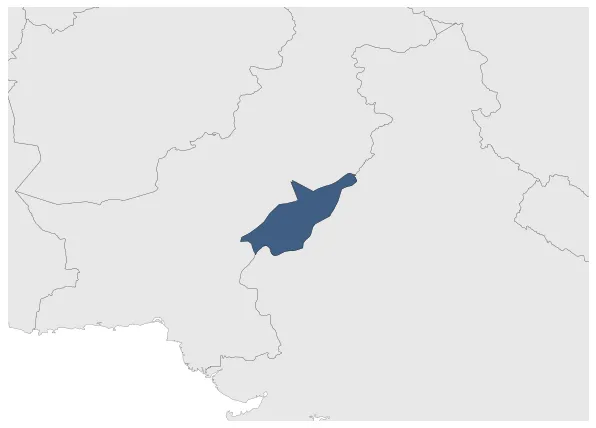
bahawalpur
If you are looking for the page with the statistics about this nation you can find it here: All Statistics
The cluster includes all the forms of the country.
The cluster includes the following incarnations of the same nation:
Bahawalpur State
Bahawalpur State (Princely State)
Establishment
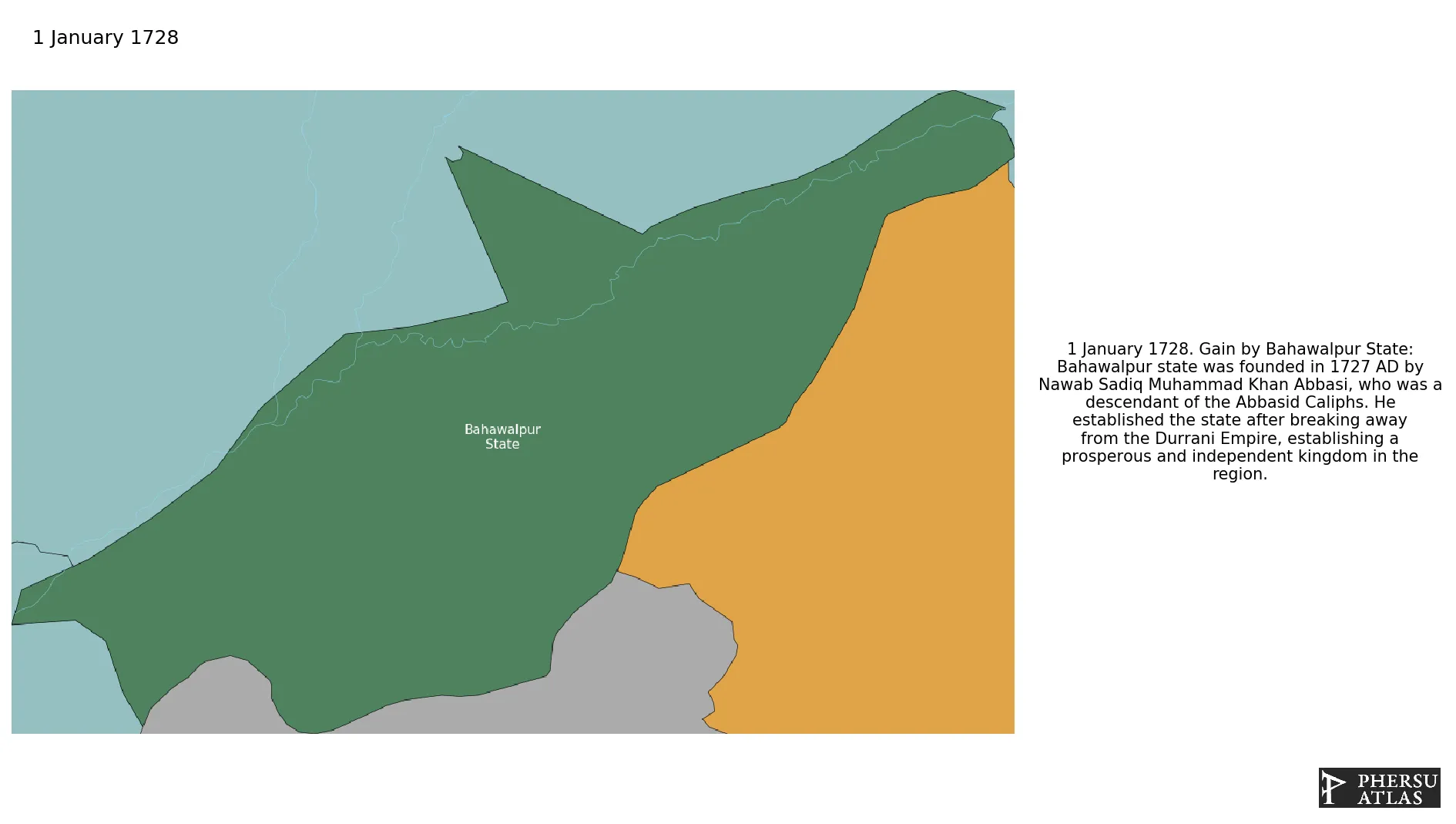
January 1728: Bahawalpur state was founded in 1727 AD by Nawab Sadiq Muhammad Khan Abbasi, who was a descendant of the Abbasid Caliphs. He established the state after breaking away from the Durrani Empire, establishing a prosperous and independent kingdom in the region.
Chronology
Interactive Chronologies with maps are available in the section Changes Navigation
Expansion during the rule of Nader Shah of the Afsharid Dynasty.
1.1.Nader Shah's invasion of the Mughal Empire
Was the invasion of India by the Afsharid ruler Nader Shah.
January 1739: Nader used the pretext of his Afghan enemies taking refuge in India to cross the border and invade the militarily weak but still extremely wealthy far eastern empire. In a brilliant campaign against the governor of Peshawar, he took a small contingent of his forces on a daunting flank march through nearly impassable mountain passes, and took the enemy forces positioned at the mouth of the Khyber Pass completely by surprise, decisively beating them despite being outnumbered two-to-one. This led to the capture of Ghazni, Kabul, Peshawar, Sindh and Lahore.
Expansion during the rule of Ranjit Singh in the Sikh Empire.
2.1.Afghan-Sikh Wars
Were a series of military conflicts between the Durrani Empire and the Sikh Empire that took place mainly in the Punjab region.
January 1779: The city of Multan reverted to Afghan rule under the suzerainty of Nawab Muzaffar Khan in 1778.
Was the partition of British India in two independent entities: India (with a Hindu majority) and Pakistan (with a Muslim majority). This included the several princely states that were dependent on the British Colony.
October 1947: British Princely states were given the option to join either Pakistan or India upon withdrawal of British suzerainty in August 1947. The city and princely state of Bahawalpur acceded to Pakistan on 7 October 1947 under Nawab Sadiq Muhammad Khan Abbasi V Bahadur.
January 1786: Bahawal Khan, the founder of the Abbasi dynasty, returned to conquer the fort of Bahawalpur in 1785 by way of Uch. He successfully re-established control of the territory, which then became known as Bahawalpur State.
January 1786: In 1785, the Durrani Empire's commander Sirdar Khan, acting on behalf of Mian Abdul Nabi Kalhora of Sindh, attacked Bahawalpur city, leading to the destruction of many buildings.
January 1802: The formal start of the Sikh Empire began with the unification of the Misls (states) by 1801, creating a unified political state.
February 1833: On 22 February 1833, Abbasi III entered into subsidiary alliance with the British, by which Bahawalpur was admitted as a princely state of British India.
Disestablishment
October 1947: British Princely states were given the option to join either Pakistan or India upon withdrawal of British suzerainty in August 1947. The city and princely state of Bahawalpur acceded to Pakistan on 7 October 1947 under Nawab Sadiq Muhammad Khan Abbasi V Bahadur.
Selected Sources
Hugh, C. (1911): Ranjit Singh, Encyclopædia Britannica, Vol. 22 (11th ed.), Cambridge (UK), p. 892