padova
If you are looking for the page with the statistics about this nation you can find it here: All Statistics
The cluster includes all the forms of the country.
The cluster includes the following incarnations of the same nation:
Padova Commune
Signoria of Padova
Establishment
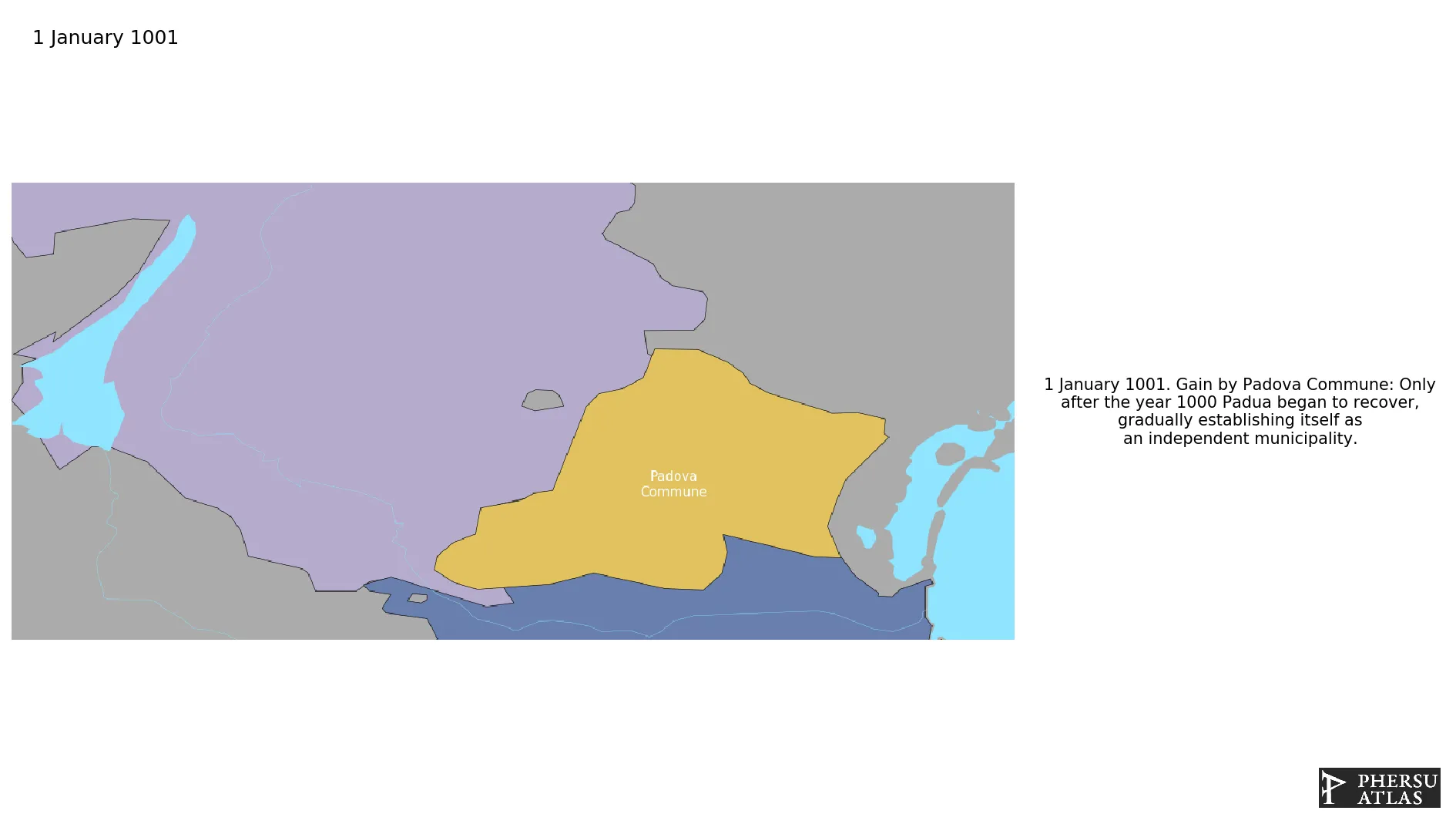
January 1001: Only after the year 1000 Padua began to recover, gradually establishing itself as an independent municipality.
Chronology
Interactive Chronologies with maps are available in the section Changes Navigation
Were a series of wars between the Signorie (Lordships) of Verona and Padova.
1.1.First Verona-Padova War
Was a war between the Signorie (Lordships) of Verona and Padova.
June 1312: In 1312, the Paduans launched a counter-offensive from Montagnana, led by the Padova Commune. They devastated Minerbe, Pressana, and Legnago, while also setting Cologna Veneta on fire.
July 1312: In 1312, the Signoria of Verona launched a counter-offensive from Montagnana, led by the Paduans. They devastated Minerbe, Pressana, and Legnago, while also setting Cologna Veneta on fire. This marked a significant event in the ongoing conflict between the Signoria of Verona and the Paduans.
January 1313: Cangrande della Scala attacked the suburbs of Padua and conquered Montagnana, which was then set on fire as a strategic move in the ongoing conflicts between the Signoria of Verona and other city-states in the region.
January 1313: Werner von Urslingen was a general in the service of the Signoria of Verona, led by Cangrande della Scala. In 1313, they attacked and destroyed the castle in Camisano Vicentino as part of their military campaign in the region.
February 1313: The forces of Cangrande della Scala leave the city of Montagnana.
February 1313: In 1313, the territory of Camisano Vicentino was attacked and its castle destroyed by Werner von Urslingen, a condottiero in the service of Padova Commune, and Cangrande della Scala, the Lord of Verona. The attack was part of the ongoing power struggles and conflicts in the region during the Middle Ages.
1.2.Second Verona-Padova War
Was a war between the Signorie (Lordships) of Verona and Padova.
December 1317: On December 20th Cangrande left Verona with the army recruited together with Uguccione della Faggiuola and Count Enrico di Gorizia: in the night they reached the city where a door had been opened by some conspirators, thus managing to conquer it without even fighting.
December 1317: The Veronese march resumed, and Montagnana also fell on the same day.
1.3.Third Verona-Padova War
Was a war between the Signorie (Lordships) of Verona and Padova.
August 1320: The troops of Verona, led by Cangrande della Scala, reached Padua in 1320.
October 1320: A peace treaty was signed at the end of October 1320 by Cangrande della Scala, ruler of Verona, and Marsilio da Carrara, ruler of Padova. This treaty marked the end of a conflict between the two city-states and resulted in territorories being ceded to the Signoria of Padova.
Were a series of wars between the Republic of Venice and the Republic of Genoa.
2.1.War of Chioggia
Was a conflict between Genoa and Venice which lasted from 1378 to 1381, from which Venice emerged triumphant.
January 1382: If on the sea the war turned in favor of Venice, on the continent its weapons certainly could not hope to compete with those of so many stubborn enemies: Castelfranco, Asolo and Noale fell into the hands of Francesco da Carrara.
2.1.1.Peace of Turin
Was the treaty that ended the War of Chioggia.
August 1381: Transfer of Cavarzere from Padua to the Republic of Venice.
January 1382: Treviso was ruled for a short time by the duke of Austria between 1381 and 1384.
January 1227: To counteract the return of the da Romano Dynasty, the castles of Vicenza were handed over to the Commune of Padua in 1226.
January 1319: In 1319, the Signoria of Padova took over the territory from the Lordship of the Carraresi, marking a shift in political power in Padua. The Carraresi were a prominent noble family in Padua who ruled the city-state for several decades before being overthrown.
January 1320: In 1318 the political order changed in Padua: the Lordship of the Carraresi began.
January 1329: In 1328 the city of Padova was conquered by Cangrande della Scala and became part of the immense territory of the lordship for a short period.
January 1338: The Scaligeri overlordship in Padua ended in 1337.
January 1369: Milan conquers Bassano.
January 1385: The da Carrara of padua took control of Treviso.
January 1389: Treviso returned definitively to the Republic of Venice, following its fortunes and wishes for the next four centuries.
January 1389: Giangaleazzo Visconti controlled the domains of Padua for two years.
January 1391: Padua is freed from Milanese domination.
April 1404: Forces fromthe Duchy of Milan besieged Vicenza in March 1404.
April 1404: In 1404, the Milanese regent Caterina Visconti asked Doge Steno of the Republic of Venice for help, offering to sell the cities of Vicenza. As a result, on April 24, the territory of Vicenza was dedicated to the Republic of Venice.
January 1405: The Paduans took Verona.
June 1405: Venice conquers Verona.
Disestablishment
January 1405: The Paduans took Verona.
June 1405: Venice conquers Verona.