tlemcen
If you are looking for the page with the statistics about this nation you can find it here: All Statistics
The cluster includes all the forms of the country.
The cluster includes the following incarnations of the same nation:
Emirate of Tlemcen
Kingdom of Tlemcen
Kingdom of Tlemcen (Marinid Vassal)
Kingdom of Tlemcen (Hafsid Vassal)
Kingdom of Tlemcen (Spanish Vassal)
Establishment
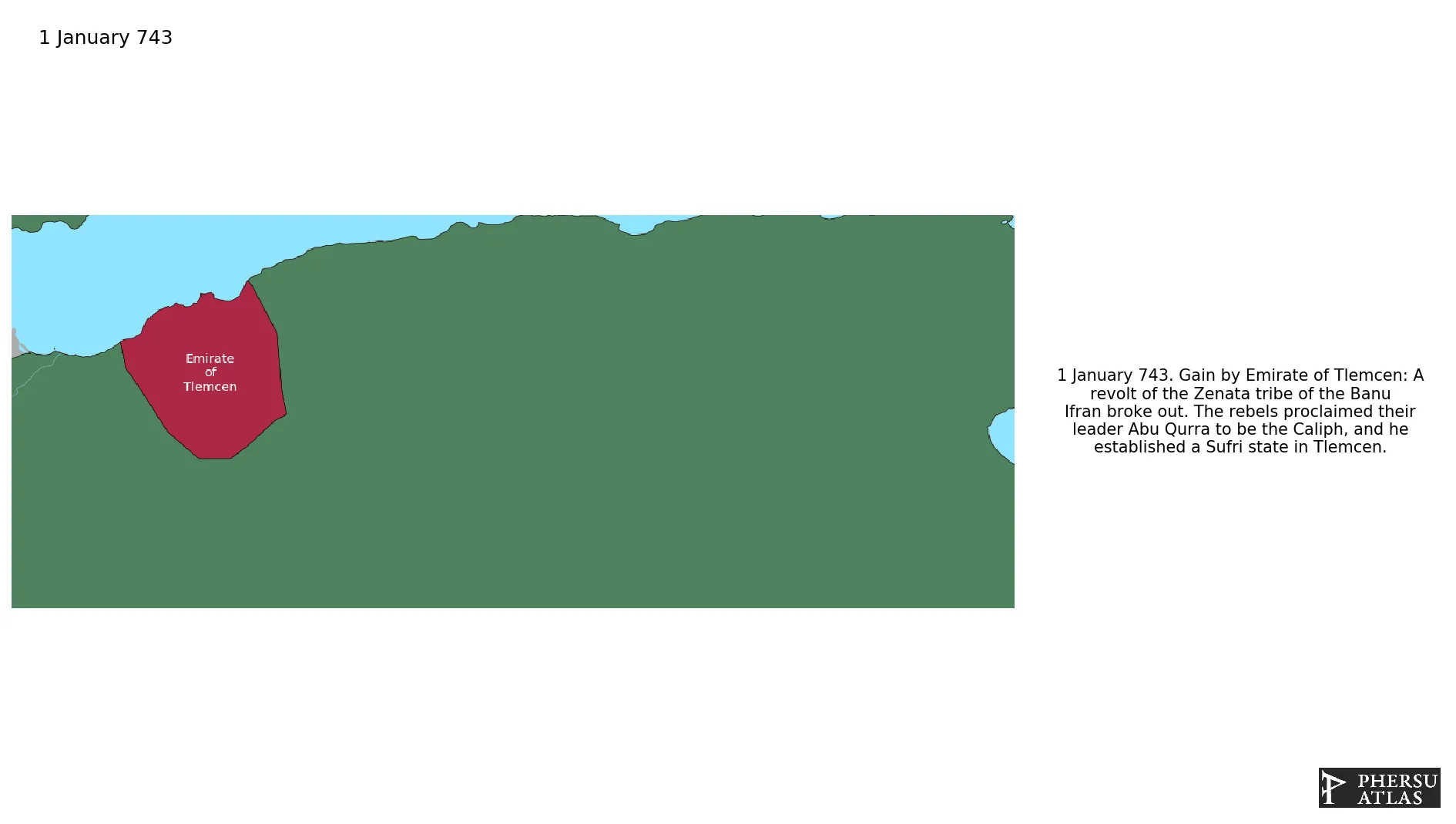
January 743: A revolt of the Zenata tribe of the Banu Ifran broke out. The rebels proclaimed their leader Abu Qurra to be the Caliph, and he established a Sufri state in Tlemcen.
Chronology
Interactive Chronologies with maps are available in the section Changes Navigation
Conquests and wars with Ottoman involvement during the rule of Suleiman I.
January 1551: The State of Tlemcen is annexed to the Regency of Algiers (1550).
January 768: Abu Qurra launched an expedition to the east, surrounded the Abbasid governor in the fortress of Tobna in the Aures and reached as far as Kairouan.
January 791: The Emirate of Tlemcen was annexed by the Rustamid dynasty.
January 1236: When the Almohad empire began to fall apart, in 1235, Yaghmurasen declared his independence.
January 1236: The Zianids declare themselves independent and make Tlemcen their capital. The central Maghreb is detached from the Almohad authority.
January 1243: The Hafsids conquered the Kingdom of Tlemcen in 1242.
January 1321: Most of the intenal area of the Hafsid Kingdom is conquered by the Kingdom of Tlemcen.
January 1336: Abu'l Hasan, the ruler of the Marinid Dynasty, initiated a siege of Tlemcen in 1335.
January 1338: Tlemcen conquered by Marinid Dynasty.
January 1348: In 1347 Marinid ruler Abu'l Hasan annexed Ifriqiya, briefly reuniting the Maghrib territories as they had been under the Almohads.
January 1349: In 1348, the Kingdom of Tlemcen experienced a revolt in the central Maghreb region. Abu Sa'id Uthman II, a Zayyanid ruler, was proclaimed as the new king of Tlemcen during this period of unrest.
January 1353: In 1352 Marinid ruler Abu Inan Faris recaptured Tlemcen. He also reconquered the central Maghreb.
January 1360: In 1359, Abu Hammu Musa II, the Zayyanid king, ascended to the throne of Tlemcen after the death of the previous ruler. The previous ruler had been forced to return to Fez due to Arab opposition and subsequently fell ill and was killed.
January 1361: The Marinids reoccupied Tlemcen in 1360.
January 1362: End of the Marinid occupation of Tlemcen.
January 1371: Tlemcen conquered by Marinid Dynasty.
January 1372: The Marinids found they were unable to hold the region of Tlemcen and thus left the area.
January 1390: In 1389, the Zayyanid dynasty in the Kingdom of Tlemcen acknowledged the suzerainty of the Marinid dynasty.
January 1401: During the 14th to 16th centuries, Mzab was part of the Zianide kingdom, with Arab communities integrating into the region during this time. In 1400, Mzab came under the control of the Kingdom of Tlemcen, a vassal of the Marinid dynasty.
January 1425: In 1424, the territory of Tlemcen came under the control of the Hafsid dynasty.
January 1501: The Zayyanids of Tlemcen recognize Hafsid suzerainty.
January 1506: In 1505, the territory of Mers El Kébir was established. It was an important port city in Algeria, known for its strategic location on the Mediterranean coast. The territory was under the control of various powers throughout its history, including the Ottoman Empire and the Spanish Empire.
May 1509: In 1509, Spanish forces captured the city of Oran, located in present-day Algeria.
January 1511: Spanish conquest of Algiers (Argel).
January 1511: In 1510, as part of the Reconquista, the Spaniards seized Bejaia, which was in the hands of dissident Hafsid emirs. They organized raids in the hinterland from this position. The Berbers of the region sought protection in the interior and took as their new capital the Kalâa of the Beni Abbas, in the heart of the Bibans mountains.
January 1513: Tlemcen becomes a vassal of Aragon.
January 1516: The Kingdom of Kuku was founded by the Kabyle Berber leader, Kuku, in 1515. It encompassed a significant portion of greater Kabylia in North Africa. Kuku was known for his military prowess and strategic leadership in uniting the Kabyle tribes under his rule.
January 1517: Hayreddin Barbarossa conquered all the hinterland and western Algeria: Mitidja, Chelif, Titteri, Dahra and Ouarsenis.
January 1517: The kingdom of Ait Abbas under Abdelaziz extended to the south and the surrounding mountains.
January 1519: Tlemcen regained independence.
January 1520: Kheireddine Barbarossa is proclaimed "Sultan of Algiers" between late October and early November 1519.
January 1521: During the 14th to 16th centuries, the region of Mzab was part of the Zianide kingdom. Arab communities began to integrate with the existing population of Mzab during this time, contributing to the cultural and social development of the region.
January 1532: Honaine conquered by spain.
January 1536: Honaine conquered by Kingdom of Tlemcen.
January 1543: Spanish occupation of the Kingdom of Tlemcen.
January 1544: In 1543, the Wattasid Dynasty took control of the Kingdom of Tlemcen, leading to the third period of Moroccan occupation.
January 1545: End of the Wattasid domination over Tlemecen.
Disestablishment
January 1551: The State of Tlemcen is annexed to the Regency of Algiers (1550).