If you are looking for the page with the statistics about this polity you can find it here:All Statistics
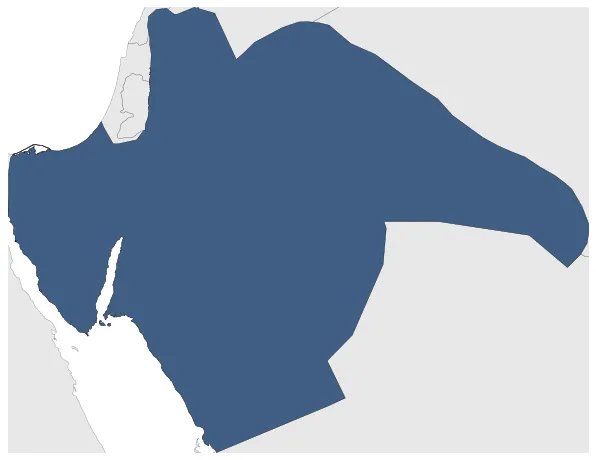
Was the Kingdom of the Nabateans, an Arab population, that emerged slowly in the territories of Sinai and Jordan. it was annexed in AD 106 by the Roman Empire, which renamed it Arabia Petraea.
Establishment
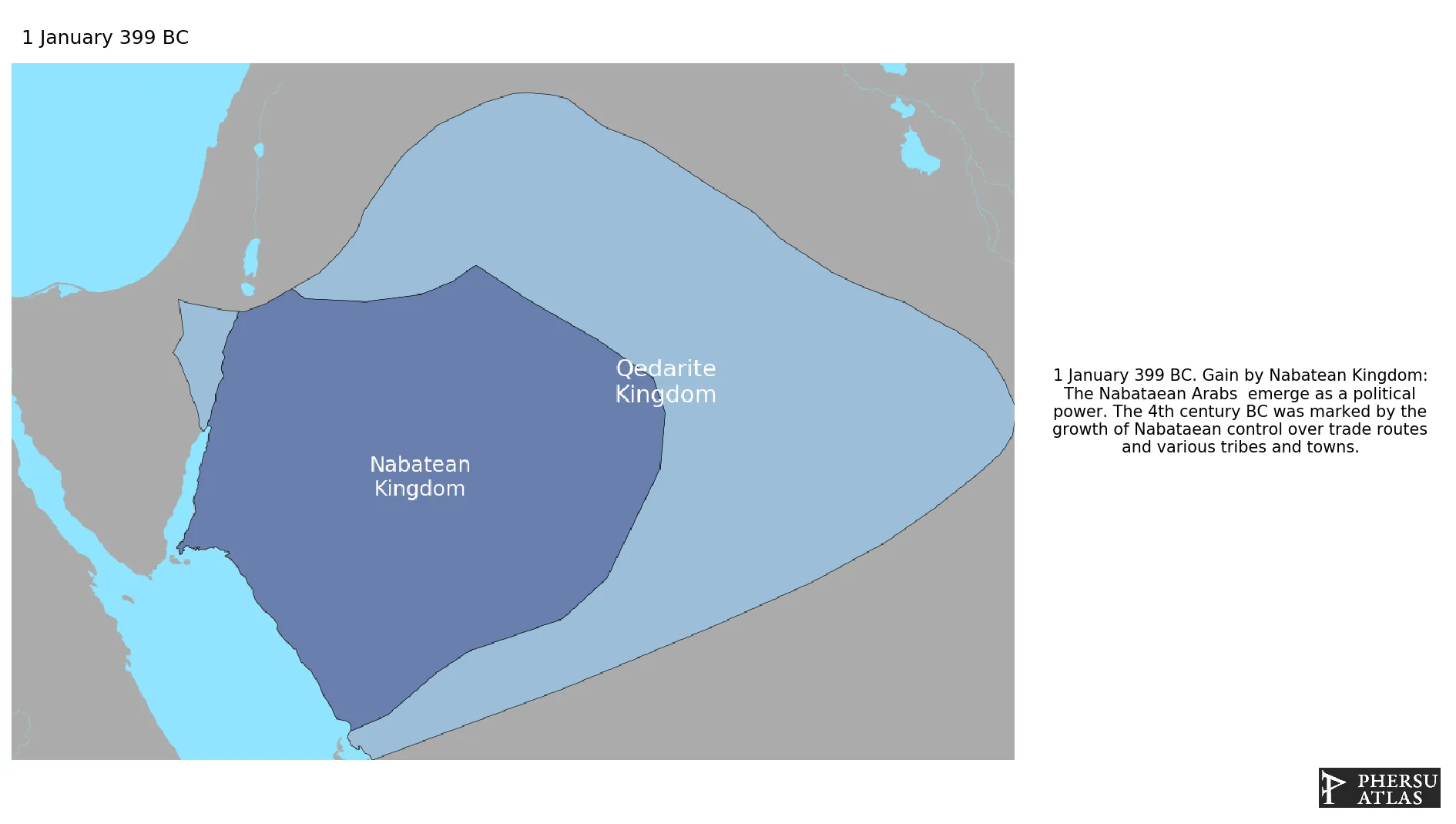
January 399 BC: The Nabataean Arabs emerge as a political power. The 4th century BC was marked by the growth of Nabataean control over trade routes and various tribes and towns.
Chronology
Interactive Chronologies with maps are available in the section Changes Navigation
Were military confrontations between the Antigonid Dynasty, one of the successors of the Macedonian Empire, and the Nabataean Kingdom.
January 311 BC: Antigonus appointed one of his officers, Athenaeus, to attack the Nabataeans. Athenaeus marched with 4000 men and 600 horsemen into Petra.
February 311 BC: The macedonians were expelled by "an 8,000 Nabataean camel cavalry force".
Were a series of military campaigns (against the Seleucid Kingdom and the Nabateans) by the Hasmonean Kings to expand their territory.
2.1.Conquests of Hyrcanus
Military campaigns of Hasmonean King Hyrcanus I.
January 109 BC: Conquests of Hyrcanus (Hasmonean Kingdom).
2.2.Conquests of Alexander Jannaeus
Military campaigns of Hasmonean King Alexander Jannaeus.
January 95 BC: Conquests of Alexander Jannaeus (Hasmonean Kingdom) by 96 BC.
2.3.Battle of Gadara
Was a battle between the Hasmoneans and the Nabataeans in 93 BC.
January 92 BC: The Hasmoneans lost the territories acquired in Transjordan during the 93 BC Battle of Gadara, where the Nabataeans ambushed Jannaeus and his forces in a hilly area. The Nabataeans saw the acquisitions as a threat to their interests, and used a large number of camels in the form of a bulldozer to push the Hasmonean forces into a deep valley where Jannaeus was "lucky to escape alive". Jannaeus returned to fierce Jewish opposition in Jerusalem after his defeat, and had to cede the acquired territories to the Nabataeans so that he could dissuade them from supporting his opponents in Judea.
Was fought between Greek Seleucid under king Antiochus XII Dionysus of Syria, and the Arab Nabataean Kingdom.
January 83 BC: The battle of Cana was fought between Greek Seleucid under king Antiochus XII Dionysus of Syria, and the Arab Nabataean Kingdom. Antiochus was slain during the combat and the battle became a decisive Nabataean victory and demoralized army fled and perished from starvation in the desert afterwards.
February 83 BC: The battle of Cana was fought between Greek Seleucid under king Antiochus XII Dionysus of Syria, and the Arab Nabataean Kingdom. Antiochus was slain during the combat and the battle became a decisive Nabataean victory and demoralized army fled and perished from starvation in the desert afterwards.
Were three conflicts fought by Rome against the Kingdom of Pontus and its allies between 88 BC and 63 BC. They are named after Mithridates VI, the King of Pontus during the course of the wars.
4.1.Third Mithridatic War
Was the last and longest of the three Mithridatic Wars, fought between Mithridates VI of Pontus and the Roman Republic. The conflict ended in defeat for Mithridates, ending the Pontic Kingdom, ending the Seleucid Empire (by then a rump state), and also resulting in the Kingdom of Armenia becoming an allied client state of Rome.
January 63 BC: Around 64 BC, the Roman General and Triumvir, Pompey had reorganised Syria and the surrounding countries into Roman provinces. Pompey had installed client kings in the region, who would become allies of Rome. Among these was Sampsiceramus I of the Emesene Dynasty.
Were a series of Wars between Rome (first the Roman Republic then the Roman Empire and finally the Eastern Roman Empire) and Persia (the Parthian Empire, and then its successor, the Sasanian Empire). The wars were ended by the early Muslim conquests, which led to the fall of the Sasanian Empire and huge territorial losses for the Byzantine Empire.
5.1.Antony's Atropatene campaign
Was a military campaign by Mark Antony, the eastern triumvir of the Roman Republic, against the Parthian Empire under Phraates IV.
5.1.1.Anthony's Invasion
Was the Roman invasion of Persia during Mark Antony's Parthian War.
October 36 BC: As his legionaries were tired and begged to return home, at the end of October, Mark Anthony decided to end the war with Persia.
Following the death of Herod the Great in 4 BC his kingdom was divided between his sister Salome I and his sons Herod Archelaus, Herod Antipas, and Philip.
January 3 BC: When Herod died in 4 BC, the kingdom was divided among his sons into the Herodian Tetrarchy.
After the deah of Nabatean king Rabbel II Soter, Nabatea was annexed to the Roman empire as the province of Arabia Petraea.
March 106: The Nabatean king Rabbel II Soter died and Nabatea was annexed to the Roman empire as the province of Arabia Petraea.
January 249 BC: The Zenon papyri, a collection of documents from the time of Ptolemy II Philadelphus, provide evidence of the Nabataeans expanding into the Hauran region around -250 BC. This marked the Nabatean Kingdom's territorial expansion and influence in the area during this period.
January 199 BC: Kindah was a tribal kingdom in central Arabia established by the Kindah tribe which emigrated from its homeland in Hadramout. The tribe's existence dates back to the 2nd century BC.
January 99 BC: The Qedarite Kingdom was absorbed into the Nabataean state during the 2nd century BC.
January 61 BC: During the reign of Aretas III (87 to 62 BC) the Nabatean Kingdom reached its territorial zenith.
Disestablishment
March 106: The Nabatean king Rabbel II Soter died and Nabatea was annexed to the Roman empire as the province of Arabia Petraea.

 Nabatean Kingdom


