Upper Egypt
If you are looking for the page with the statistics about this polity you can find it here:All Statistics
Was a kingdom in southern Egypt that merged with Lower Egypt to form the Ancient Kingdom of Egypt around 3250 BC. The kingdom also existed several time as a secessionist state.
Establishment
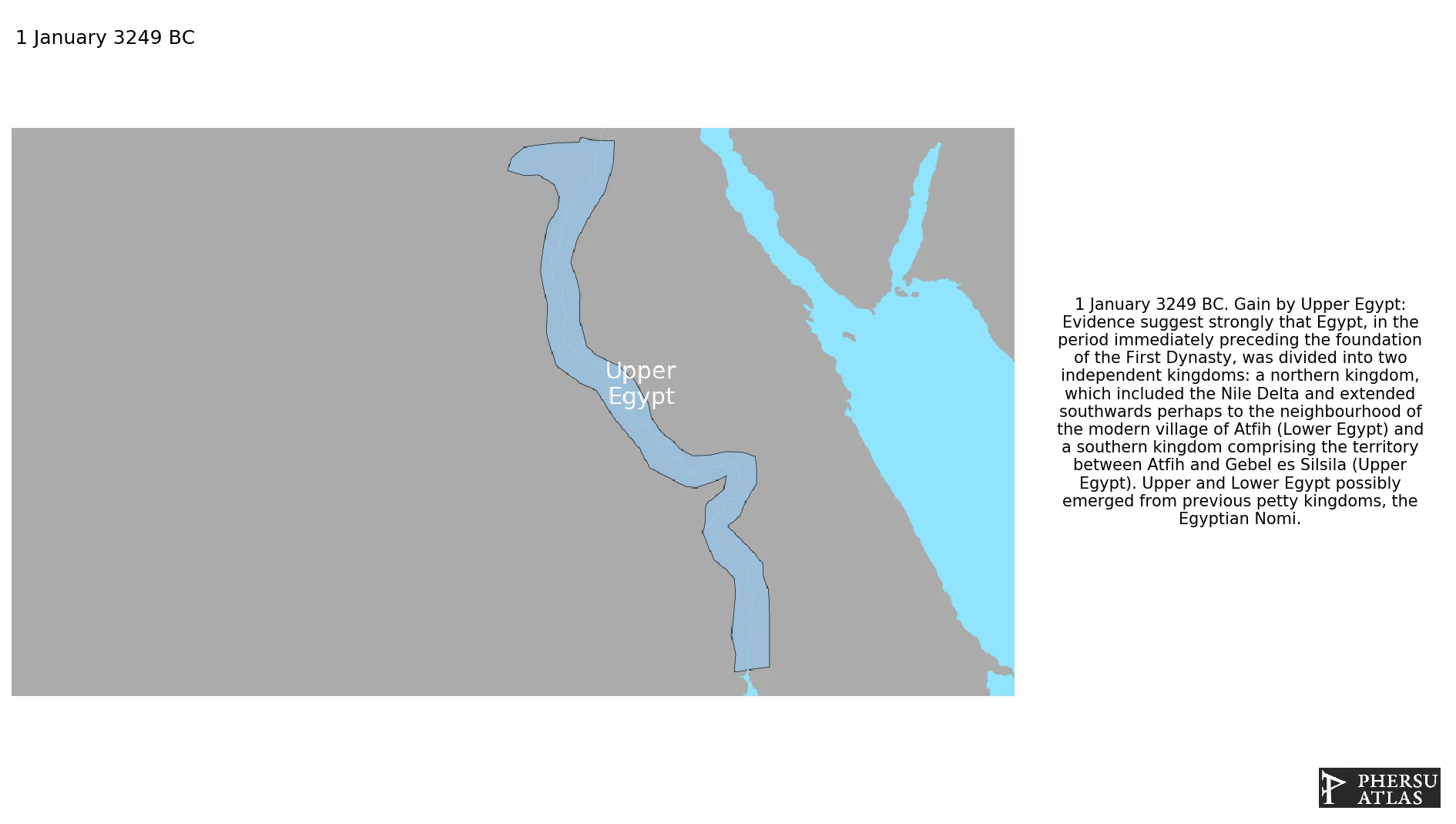
January 3249 BC: Evidence suggest strongly that Egypt, in the period immediately preceding the foundation of the First Dynasty, was divided into two independent kingdoms: a northern kingdom, which included the Nile Delta and extended southwards perhaps to the neighbourhood of the modern village of Atfih (Lower Egypt) and a southern kingdom comprising the territory between Atfih and Gebel es Silsila (Upper Egypt). Upper and Lower Egypt possibly emerged from previous petty kingdoms, the Egyptian Nomi.
Chronology
Interactive Chronologies with maps are available in the section Changes Navigation
Upper and Lower Egypt were unified in c. 3150 BC, starting the Early Dynastic Period of Egypt.
January 3149 BC: Unification of Upper and Lower Egypt in c. 3150 BC and start of the Early Dynastic Period, also known as Archaic Period or the Thinite Period.
It is believed that in ca. 2700 BC the Egyptian Pharaoh decided to split the Kingdom of Ancient Egypt between his two sons.
2.1.Split of Ancient Egypt in Lower and Higher Egypt
It is believed that in ca. 2700 BC the Egyptian Pharaoh decided to split the Kingdom of Ancient Egypt between his two sons.
January 2699 BC: Partition of Egypt into Lower and Upper Egypt. It is believed that Egyptian Pharaoh Senedj split Egypt between his two sons.
2.2.Reunification of Lower and Higher Egypt
The division of Egypt that happened in ca. 2700 BC was brought to an end by king Khasekhemwy.
January 2689 BC: The division of Egypt was brought to an end by Pharaoh Khasekhemwy.
Was a period of weak central power in Ancient Egypt.
January 2169 BC: The First Intermediate Period was a dynamic time in which rule of Egypt was roughly equally divided between two competing power bases. One of the bases was at Heracleopolis in Lower Egypt, a city just south of the Faiyum region, and the other was at Thebes, in Upper Egypt.
January 2024 BC: The Theban ruler Mentuhotep II, after his rise around 2025 B.C., reunited Lower and Upper Egypt.
Was a period of political instability that followed the death of Pharaoh Ramesses XI and coincided with the Late Bronze Age collapse.
January 833 BC: Egypt quickly fragmented after Rudamun's death, with the rise of local city states under kings such as Peftjaubast of Herakleopolis, Nimlot of Hermopolis, and Ini at Thebes. He is believed to have ascended to the throne of a divided Egypt in either 845 BC or 834 BC.
January 814 BC: After the death of Rudamun, the final pharaoh of the Twenty-third Dynasty of Egyp, his kingdom quickly fragmented with the rise of local city states such as Peftjaubast of Herakleopolis and Nimlot of Hermopolis.
January 814 BC: Rise of local city states under kings such as Peftjaubast of Herakleopolis.
Was a revolt against the Ptolemaic Kingdom in Upper Egypt.
January 216 BC: Nationalist sentiment had developed among the native Egyptians who had fought at Raphia. Confident and well-trained, they broke from Ptolemy in what is known as the Egyptian Revolt, establishing their own kingdom in Upper Egypt which the Ptolemies finally reconquered around 185 BC.
Was a revolt against the Ptolemaic Kingdom in Upper Egypt.
January 184 BC: The war between Upper and Lower Egypt continued until 185 BC with the arrest of Ankhmakis by Ptolemaic general Conanus. This victory re-established Ptolemaic rule in Upper Egypt, as well as the Triakontaschoinos.
Disestablishment
January 184 BC: The war between Upper and Lower Egypt continued until 185 BC with the arrest of Ankhmakis by Ptolemaic general Conanus. This victory re-established Ptolemaic rule in Upper Egypt, as well as the Triakontaschoinos.
Selected Sources
Bunson, M.R. (2014): Encyclopedia of Ancient Egypt, Infobase Publishing, p. 405
Edwards, I.E.S. / Gadd, C.J. / Hammond, N.G.L. (2008): The Cambridge Ancient History, 3rd ed., Vol. I, Part 2, Cambridge University Press, p. 1
Francesco Tiradritti & Anna Maria Donadoni Roveri: Kemet: Alle Sorgenti Del Tempo. Electa, Milano 1998, ISBN 88-435-6042-5, page 80–85.
Gardiner, Alan (1961) Egypt of the Pharaohs (Oxford University Press), 107–109.
Hermann Alexander Schlögl: Das Alte Ägypten: Geschichte und Kultur von der Frühzeit bis zu Kleopatra. Beck, Hamburg 2006, ISBN 3-406-54988-8, page 77-78 & 415.
Nicolas Grimal: A History of Ancient Egypt. Wiley-Blackwell, Weinheim 1994, ISBN 978-0-631-19396-8, page 55.
Steindorff, G. (1909): Die ägyptischen Gaue und ihre politische Entwicklung, Abhandlungen der Königl. Sächsischen Gesellschaft der Wissenschaften, Vol. 57, S. Hirzel, Leipzig, pp. 880-884
Szpakowska, K. (2007): Daily Life in Ancient Egypt, John Wiley & Sons, p.4