If you are looking for the page with the statistics about this nation you can find it here: All Statistics
The cluster includes all the forms of the country.
The cluster includes the following incarnations of the same nation:
Caucasian Albania
Caucasian Albania (Rome)
Establishment
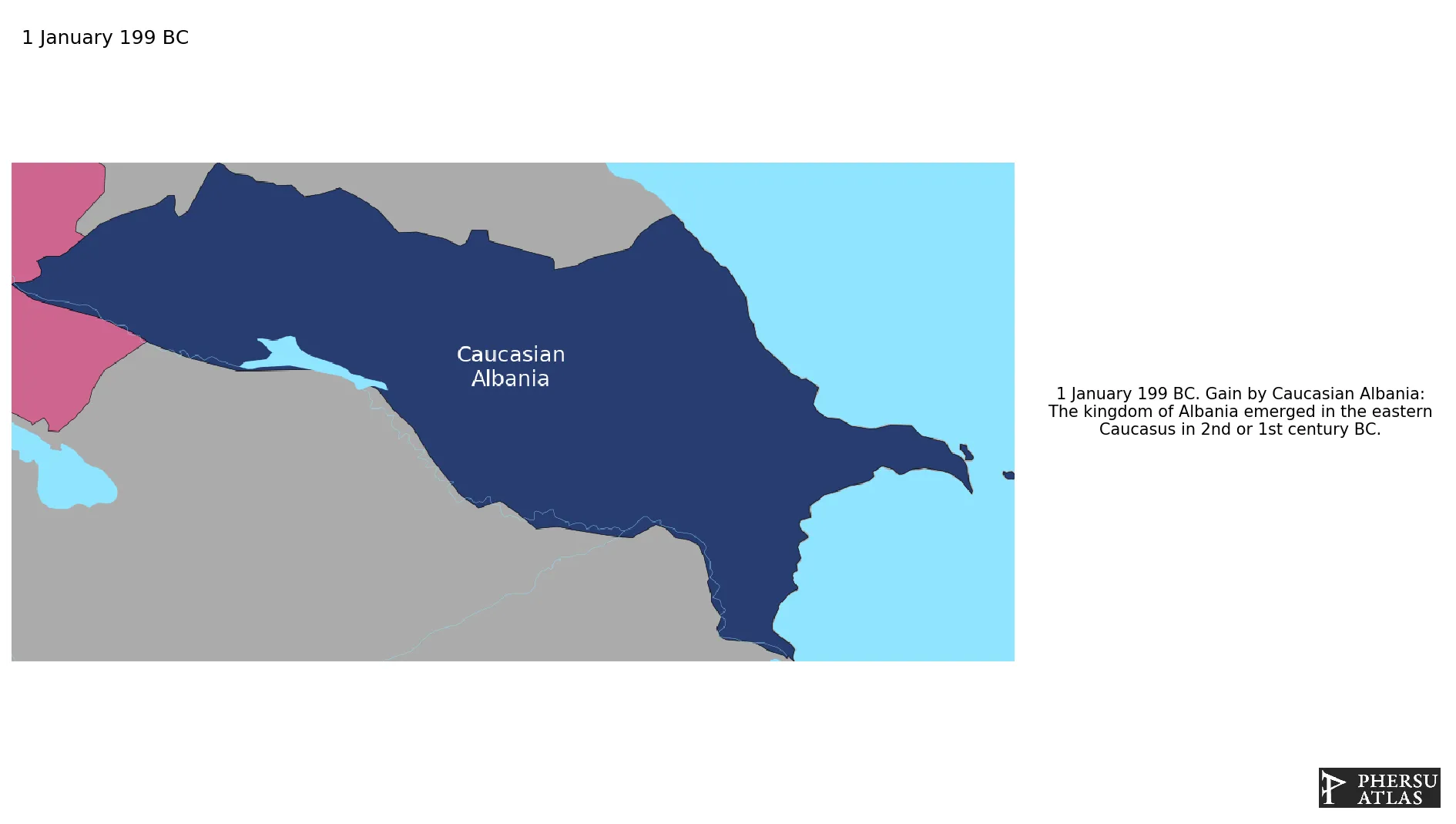
January 199 BC: The kingdom of Albania emerged in the eastern Caucasus in 2nd or 1st century BC.
Chronology
Interactive Chronologies with maps are available in the section Changes Navigation
Were three conflicts fought by Rome against the Kingdom of Pontus and its allies between 88 BC and 63 BC. They are named after Mithridates VI, the King of Pontus during the course of the wars.
1.1.Third Mithridatic War
Was the last and longest of the three Mithridatic Wars, fought between Mithridates VI of Pontus and the Roman Republic. The conflict ended in defeat for Mithridates, ending the Pontic Kingdom, ending the Seleucid Empire (by then a rump state), and also resulting in the Kingdom of Armenia becoming an allied client state of Rome.
January 65 BC: After the conquest of Armenia by the Romans in 66 BC it lost many of its areas, so that the southern border of Albania shifted to the Aras River.
1.1.1.Caucasian campaign of Pompey
Was a succesful Roman military campaign led by Gnaeus Pompeius Magnus in the Caucasus during the Third Mithridatic War.
January 64 BC: The Caucasian Albani decided to act before the Romans could invade. Oroeses, king of the Albani, organized a concerted attack on the divided Roman forces. The attacks were to coincide with the Roman feast of Saturnalia to maximize their success. Unfortunately the capably led veteran Roman forces were more than a match for the Albani tribesmen and their attacks were easily repulsed. Oroeses was forced to submit to terms.
Was a military campaign waged by Julius Caesar (at the same time of his war against Pompeius) that lead to the Roman submission of the Kingdom of Pontus.
January 47 BC: Pharnace of Pontus moved to the southeast along the Black Sea coast and without difficulty subjugated Colchis and all of Armenia.
August 47 BC: Caesar decisively defeated Pharnaces of Pontus at the Battle of Zela. Pharnaces was killed and Caesar conquered Pontus. In addition, the territories occupied by Pharnaces were freed.
Were a series of Wars between Rome (first the Roman Republic then the Roman Empire and finally the Eastern Roman Empire) and Persia (the Parthian Empire, and then its successor, the Sasanian Empire). The wars were ended by the early Muslim conquests, which led to the fall of the Sasanian Empire and huge territorial losses for the Byzantine Empire.
January 348: The treaty of Nisibis stipulated the reestablishment of the Roman protectorate over Caucasian Iberia and Albania. But fifty years later Rome lost the area that since then remained an integral part of the Sasanian Empire.
3.1.Roman-Parthian War of 161-166
Was a war fought between the Roman and Parthian Empires over Armenia and Upper Mesopotamia.
January 165: In 164 AD, Pacorus, the Parthian ruler of Armenia, was deposed. The former Roman consul of Emesa, Gaius Julius Soemus, who had been deposed by Vologeses, was then crowned as the new tributary king of Armenia under Roman rule.
3.2.Mesopotamian Campaign of Ardashir I
Was a military campaign by Sassanid King Ardashir I against the Roman Empire.
January 241: Sassanians occupied Caucasian Albanian around 240 AD.
January 189 BC: In the 2nd century BC, Armenia was established in the parts of Caucasian Albania to the right of the Kura River.
January 189 BC: The defeat of the Seleucid King Antiochos III by the Romans at Magnesia Sipylus in 190 BC redraws the political map of the Middle East. Under the terms of the Peace of Apamea (188 BC), Antiochus III could no longer intervene north of the Taurus, creating a political vacuum which was immediately filled by new independent kingdoms. From 190 BC. BC, the satrap of Armenia Artaxias, with whom the Carthaginian Hannibal took refuge, founded on his advice the city of Artaxates (south of present-day Yerevan) on the banks of the Araxes, and makes it the capital of a kingdom of Armenia of which he proclaims himself king, with the blessing of the Romans.
January 246: In 245, the Roman Empire regained control of Caucasian Albania under the rule of Emperor Philip the Arab. This marked a period of Roman influence in the region, with Caucasian Albania becoming a client state of Rome.
Disestablishment
January 348: The treaty of Nisibis stipulated the reestablishment of the Roman protectorate over Caucasian Iberia and Albania. But fifty years later Rome lost the area that since then remained an integral part of the Sasanian Empire.
Selected Sources
Appian, XII - The Mithridatic Wars, 116-117
Plutarch: Parallel Lives, Pompey, 45.2-5

 caucasian albania


