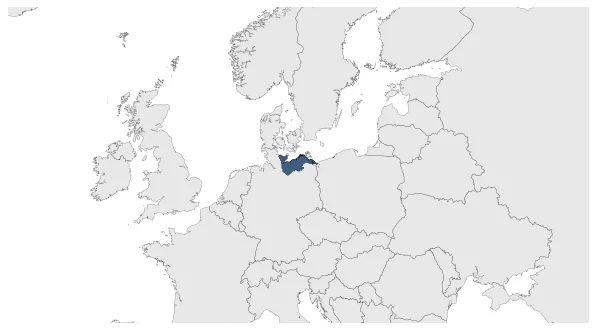
billung march
If you are looking for the page with the statistics about this nation you can find it here: All Statistics
The cluster includes all the forms of the country.
The cluster includes the following incarnations of the same nation:
Billung Mark (East Francia)
Billung Mark
Establishment
January 936: The Billung March was formed in 936, when Otto II, Duke of Saxony and King of East Francia, made Hermann Billung princeps militiae (margrave, literally "prince of the militia"), granting him control of the border with rule over the West Slavic Obotrite tribes, including the Polabians, Warnabi and Wagri, as well as the Redarii, Circipani, and Kissini tribes of the Veleti confederation, and the Danes, who had repeatedly campaigned the territory.
Chronology
Interactive Chronologies with maps are available in the section Changes Navigation
The Magyars (or Hungarians) successfully conquered the Carpathian Basin (corresponding to the later Kingdom of Hungary) by the end of the ninth century, and launched a number of plundering raids thoughout Europe.
January 937: Hungarian raid against Saxony (in 936).
February 937: Hungarian raid against Saxony (in 936). The territories were left after the raid.
January 939: In 938, the Magyars repeatedly attacked Saxony.
February 939: In 938, the Magyars repeatedly attacked Saxony. The territories were left after the raid.
The Frankish Kingdom was partitioned and reuinited several times as the Frankish rulers used to divide their territories equally among their heirs. This lead also to a number of wars and revolts.
2.1.Incoronation of Otto I
East Frankish King Otto I was crowned first Holy Roman Emperor.
February 962: The Billung March was formed in 936, when Otto II, Duke of Saxony and King of East Francia, made Hermann Billung princeps militiae (margrave, literally "prince of the militia"), granting him control of the border with rule over the West Slavic Obotrite tribes, including the Polabians, Warnabi and Wagri, as well as the Redarii, Circipani, and Kissini tribes of the Veleti confederation, and the Danes, who had repeatedly campaigned the territory.
January 961: From c. 960 Harald Bluetooth appears to have established a kingdom in the lands of the Danes which stretched from Jutland to Skåne.
Disestablishment
January 984: Like the adjacent Northern March, the March of Billung was finally abandoned following the uprising of the Obotrites and Veleti in 983.
Selected Sources
Reuter, T. (1995): The New Cambridge Medieval History: c. 900-c. 1024, Cambridge University Press, p. 543