
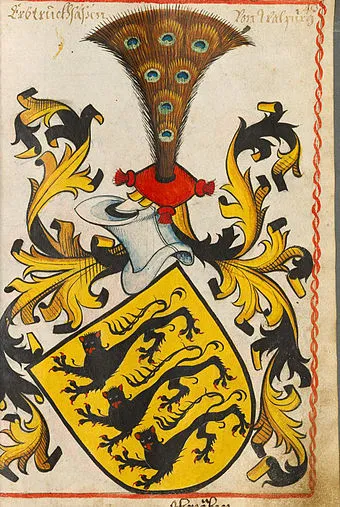
Most recent flag or coat of arms
Video Summary
Video Summary
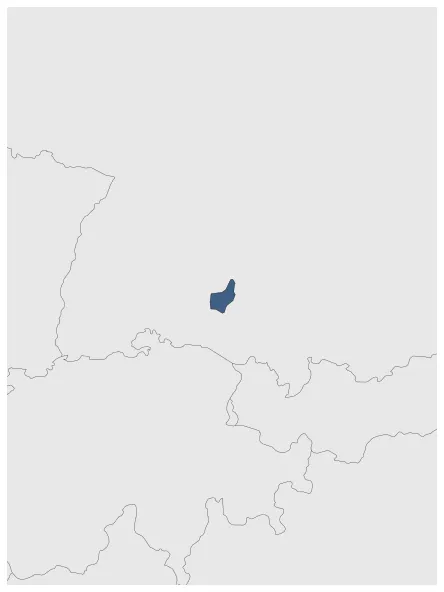
Maximum Extent
Maximum Extent (Interactive Map)

Data

Name: scheer

Type: Cluster

Start: 1454 AD

End: 1806 AD

Statistics

All Statistics: All Statistics

Icon scheer

If you are looking for the page with the statistics about this nation you can find it here: All Statistics

The cluster includes all the forms of the country.

The cluster includes the following incarnations of the same nation:

  • Lordship of Scheer
  • Scheer County
  • Princely County of Scheer
  • Establishment


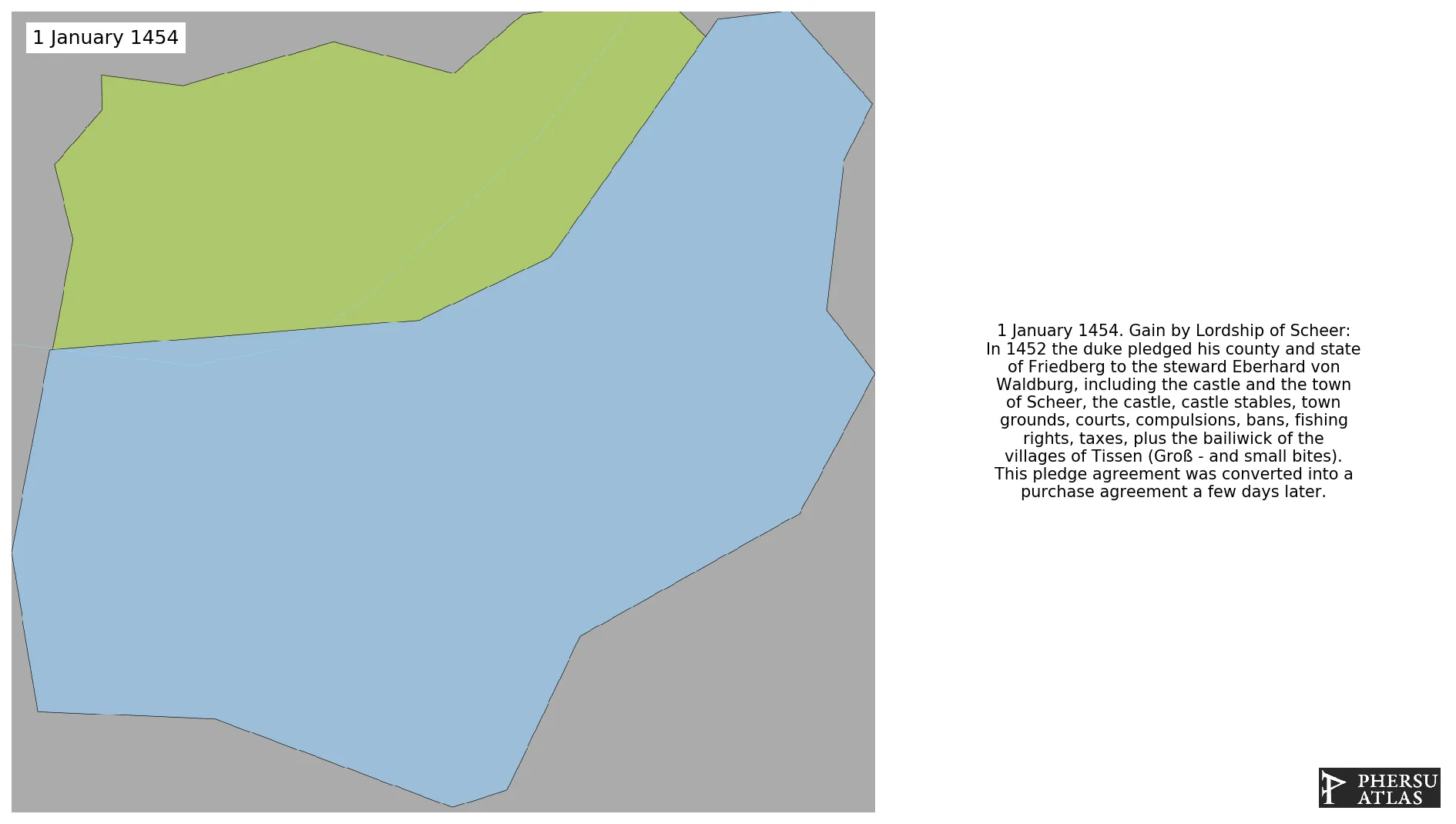
  • January 1454: In 1452 the duke pledged his county and state of Friedberg to the steward Eberhard von Waldburg, including the castle and the town of Scheer, the castle, castle stables, town grounds, courts, compulsions, bans, fishing rights, taxes, plus the bailiwick of the villages of Tissen (Groß - and small bites). This pledge agreement was converted into a purchase agreement a few days later.
  • Chronology


    Interactive Chronologies with maps are available in the section Changes Navigation

    1. European wars of religion


    Were a series of wars in Europe (and the overseas possessions of European countries) the 16th, 17th and early 18th that started after the Protestant Reformation. Although the immediate causes of the wars were religious, the motives were complex and also included territorial ambitions.

    1.1.Thirty Years' War

    Was a war that took place mainly in central Europe between 1618 and 1648. The war began as a religious conflict between Catholics and Protestant in the Holy Roman Empire but then escalated into a conflict for the hegemony in Europe between Habsburg Spain and Austria, Sweden and France.

    1.1.1.Franco-Swedish Period

    Was the fourth main period of the Thirty Years' War. It started with the intervention of the Kingdom of France.

    1.1.1.1.North German Front (Sweden)

    Was the north German front during the Franco-Swedish period of the Thirty Years' War.

  • November 1648: When in November Gustaf of Sweden received a report about the signed peace, he ordered his troops to leave. Also the French troops started leaving the occupied territories in the Holy Roman Empire.

  • 1.1.1.2.Rhineland Front (France)

    Was the Rhineland front during the Franco-Swedish period of the Thirty Years' War.

  • May 1648: The French returned to Swabia and then to Bavaria. They defeated the Imperial forces at Zusmarshausen (May 17, 1648) and drove Maximilian of Bavaria out of Munich.

  • 2. French Revolutionary and Napoleonic Wars


    Were a series of conflicts between France and several European monarchies between 1792 and 1815. They encompass first the French Revolutionary Wars against the newly declared French Republic and from 1803 onwards the Napoleonic Wars against First Consul and later Emperor Napoleon Bonaparte. They include the Coalition Wars as a subset: seven wars waged by various military alliances of great European powers, known as Coalitions, against Revolutionary France - later the First French Empire - and its allies.

  • January 1807: In 1806, due to the Rhine Confederation Act, Scheer came to the Kingdom of Württemberg and was assigned to the Oberamt Saulgau.

  • 2.1.War of the Second Coalition

    Was the second war that saw revolutionary France against most of the European monarchies, led by Britain, Austria, and Russia, and including the Ottoman Empire, Portugal, Naples, and various German monarchies. Prussia did not join this coalition, and Spain supported France.

    2.1.1.German Front (War of the Second Coalition)

    Was the German theatre of the War of the Fifth Coalition.

  • March 1799: On 1 March 1799, the French Army of Observation, in an order of battle of approximately 30,000 men in four divisions, crossed the Rhine at Kehl and Basel.
  • March 1799: At the intensely fought Battle of Ostrach, 21-22 March 1799, French suffered significant losses and were forced to retreat from the region, taking up new positions to the west at Messkirch.
  • May 1800: French forces movement to fight at nearby Biberach an der Ris.

  • 2.1.2.Treaty of Lunéville

    Was a treaty between the French Republic and the Holy Roman Empire that formally ended the partecipation of Austria and the Holy Roman Empire in the War of the Second Coalition.

  • February 1801: The Treaty of Lunéville was signed in the Treaty House of Lunéville between the French Republic and Holy Roman Emperor Francis II. Certain Austrian holdings within the borders of the Holy Roman Empire were relinquished, and French control was extended to the left bank of the Rhine, "in complete sovereignty" but France renounced any claim to territories east of the Rhine. Contested boundaries in Italy were set. The Grand Duchy of Tuscany was awarded to the French.

  • 2.2.War of the Third Coalition

    Was a European conflict spanning the years 1805 to 1806. During the war, France and its client states under Napoleon I opposed an alliance, the Third Coalition, made up of the United Kingdom, the Holy Roman Empire, the Russian Empire, Naples, Sicily, and Sweden. Prussia remained neutral during the war.

    2.2.1.Ulm Campaign

    Was a series of French and Bavarian military maneuvers and battles to outflank and capture an Austrian army in 1805 during the War of the Third Coalition. It took place in the vicinity of and inside the city of Ulm.

  • October 1805: The French army crossed the Danube at Donauwörth.

  • 2.2.2.Peace of Pressburg

    Was the treaty that ended the War of the Third Coalition.

  • December 1805: French evacuation of occupied territories after the Peace of Pressburg.

  • 3. Further events (Unrelated to Any War)


  • January 1464: Establishment of the Scheer County.

  • January 1786: Scheer is elevated to a princely county.

  • Disestablishment


  • January 1807: In 1806, due to the Rhine Confederation Act, Scheer came to the Kingdom of Württemberg and was assigned to the Oberamt Saulgau.
  • Selected Sources


  • Gagliardo, J. (1980): Reich and Nation: The Holy Roman Empire as Idea and Reality, 1763–1806, Bloomington (USA), p. 192
  • Krumenacker, Y. (2008): La Guerre de Trente Ans, Paris, Ellipses, pp. 146-147
  • Oberfinanzrath von Memmingen (1837): Beschreibung des Oberamts Biberach, Stuttgart and Tübingen (Germany), p. 95
  • Phillipson, C. (2008): Termination of War and Treaties of Peace, Clark (USA), p. 273
  • Poole, R.L. (1902): Historical Atlas of Modern Europe, Oxford (United Kingdom), Plate XI
  • Schmiele, E. (1887): Zur Geschichte des schwedisch-polnischen Krieges von 1655 bis 1660, Berlin (Germany), p. 5
  • All Phersu Atlas Regions

    Africa

    Americas

    Asia

    Europe

    Oceania