If you are looking for the page with the statistics about this nation you can find it here: All Statistics
The cluster includes all the forms of the country.
The cluster includes the following incarnations of the same nation:
County of Oldenburg
County of Oldenburg (Denmark)
Duchy of Oldenburg
Granduchy of Oldenburg
Establishment
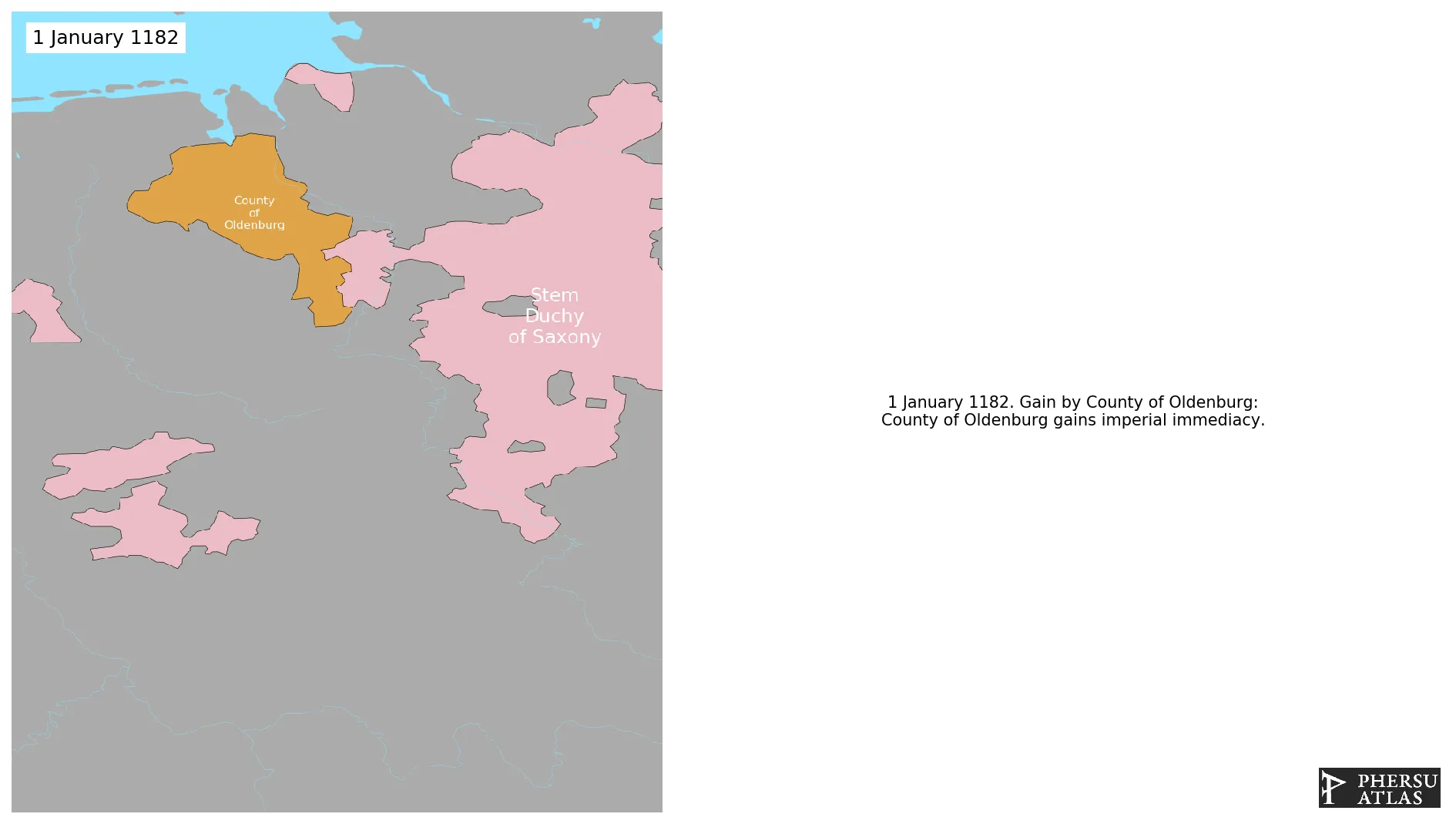
January 1182: County of Oldenburg gains imperial immediacy.
Chronology
Interactive Chronologies with maps are available in the section Changes Navigation
The Crusades were a series of religious wars initiated, supported, and sometimes directed by the Latin Church in the Medieval period. The best known of these military expeditions are those to the Holy Land in the period between 1095 and 1291.
1.1.Stedinger Crusade
Was a Papally-sanctioned war against the rebellious peasants of Stedingen, in the Archibishopric of Bremen.
January 1205: In 1204, the Stedinger north of the Hunte rebelled against the count of Oldenburg, burning to the ground two of his castles. Their revolt spread south of the Hunte, where the archbishop's ministerials were driven off.
January 1235: The archbishop of Bremen mobilized his church and the Papacy to have a crusade sanctioned against the rebels of Stedingen. In the first campaign, the small crusading army was defeated. In a follow-up campaign the next year, a much larger crusader army was victorious.
Were a series of conflicts between France and several European monarchies between 1792 and 1815. They encompass first the French Revolutionary Wars against the newly declared French Republic and from 1803 onwards the Napoleonic Wars against First Consul and later Emperor Napoleon Bonaparte. They include the Coalition Wars as a subset: seven wars waged by various military alliances of great European powers, known as Coalitions, against Revolutionary France - later the First French Empire - and its allies.
February 1803: With the German Mediatisation of 1803, Oldenburg acquired the Oldenburg Münsterland and the Prince-Bishopric of Lübeck.
January 1804: The Lübeck Prince-Bishopric is secularised to Oldenburg.
January 1811: Between 1810 and 1814, Oldenburg was occupied by Napoleonic France. Its annexation into the French Empire, in 1810, was one of the causes for the diplomatic rift between former allies France and Russia.
2.1.War of the Sixth Coalition
Was a war between France and a a coalition of Austria, Prussia, Russia, Spain, the United Kingdom, Portugal, Sweden, and a number of German States. The coalition emerged after the decimation of the French army in the French invasion of Russia. The coalition ultimately invaded France and forced Napoleon to abdicate and go into exile.
January 1814: Kniphausen is annexed by Oldenburg.
2.1.1.Treaty of Paris (1814)
Was the treaty that ended the war between France and the Sixth Coalition, part of the Napoleonic Wars.
May 1814: Oldenburg administration in Jever.
May 1814: Jever is occupied by Russia.
May 1814: Vechta and part of the Bishopric of Lübeck are acquired by Oldenburg.
2.2.Congress of Vienna
Was a series of international diplomatic meetings after the end of the Napoleonic wars whose aim was a long-term peace plan for Europe. It redraw the borders of Europe and partially restored the Monarchies of the pre-revolutionary period.
June 1815: In addition, Oldenburg received the Principality of Birkenfeld an der Nahe as a further exclave alongside the Principality of Lübeck, so that the national territory now comprised three parts.
June 1815: The Grand Duchy of Oldenburg was a territory reestablished by the Congress of Vienna in 1815.
Were a series of wars that resulted in the creation of the German Empire under Prussian leadership in 1871.
3.1.Franco-Prussian War
Was a war that saw the Second French Empire fight against an alliance of German states led by the Kingdom of Prussia. The war was caused by the struggle over dominance in continental Europe between Prussia and France. The German states were victorious and in 1871 merged to form the German Empire. France was occupied and forced to cede Alsace-Lorraine to Germany.
3.1.1.Unification of Germany (1871)
Was the unification of 25 German states into the German Empire under the leadership of the Kingdom of Prussia, officially proclaimed on 18 January 1871, in the Hall of Mirrors at the Palace of Versailles in France.
January 1871: In 1871, Oldenburg joined the German Empire.
January 1200: Bruchhausen County is partitioned from Wildeshausen.
January 1271: In 1270 the settlement of Wildeshausen belonged to the Archbishopric of Bremen.
January 1302: The last count was Otto von Wölpe (1258-1307), who had entered the clergy. He had no male heirs and sold the county of Wölpe to Count Otto von Oldenburg-Delmenhorst in 1301.
January 1303: The County of Wölpe was to Duke of Brunswick-Lüneburg Otto the Strict in 1302 for 6,500 silver marks.
January 1478: Based on Gustav Droysen's Map of the Holy Roman Empire in the XV century.
January 1483: The city of Delmenhorst fell under Munster rule.
January 1548: Count Anton I of Oldenburg recaptured the castle and county of Delmenhorst.
January 1576: The Jever Lordship is annexed by Oldenburg.
January 1654: Establishment of the Kniphausen Lordship.
June 1667: In 1667, after Count Anton Günther of Oldenburg died without heirs, the territory passed under Danish rule.
January 1668: Jever is annexed to Anhalt-Zerbst.
August 1773: Treaty of Tsarskoye Selo 1773.
December 1774: Oldenburg is raised to duchy.
January 1819: After the withdrawal of the Napoleonic troops, Russia regained its rights over Jever in 1813, but ceded the rule of Jever to the Grand Duchy of Oldenburg in 1818.
Disestablishment
January 1871: In 1871, Oldenburg joined the German Empire.
Selected Sources
Droysen, G. (1886): Historischer Handatlas, Bielefeld and Leipzig (Germany), pp. 34-35
Köbler, G. (2014) Historische Enzyklopädie der Länder der Deutschen, C.H. Beck München, pp. 28-31
O'Mahony, C. I. (2013). War within the Walls: Conflict and Citizenship in the Murals of the Hôtel de Ville, Paris. Journal of War & Culture Studies, 6(1), 6-23.

.svg.png.webp)
 oldenburg


