If you are looking for the page with the statistics about this nation you can find it here: All Statistics
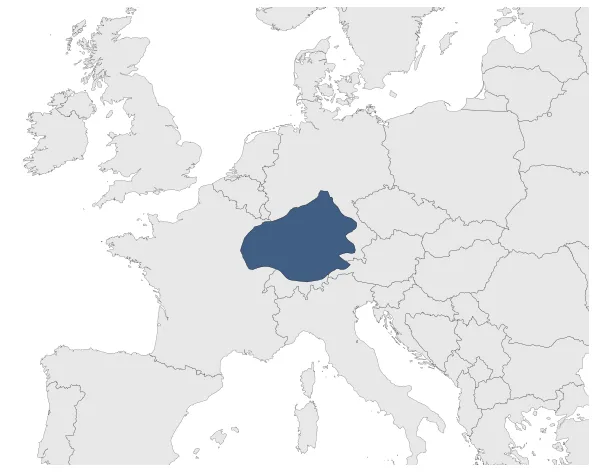
The cluster includes all the countries established by the Alemanni during Antiquity and the Middle Ages.
The cluster includes the following incarnations of the same nation:
Kingdom of the Alemanni
Kingdom of the Alemanni (Frankish)
Establishment
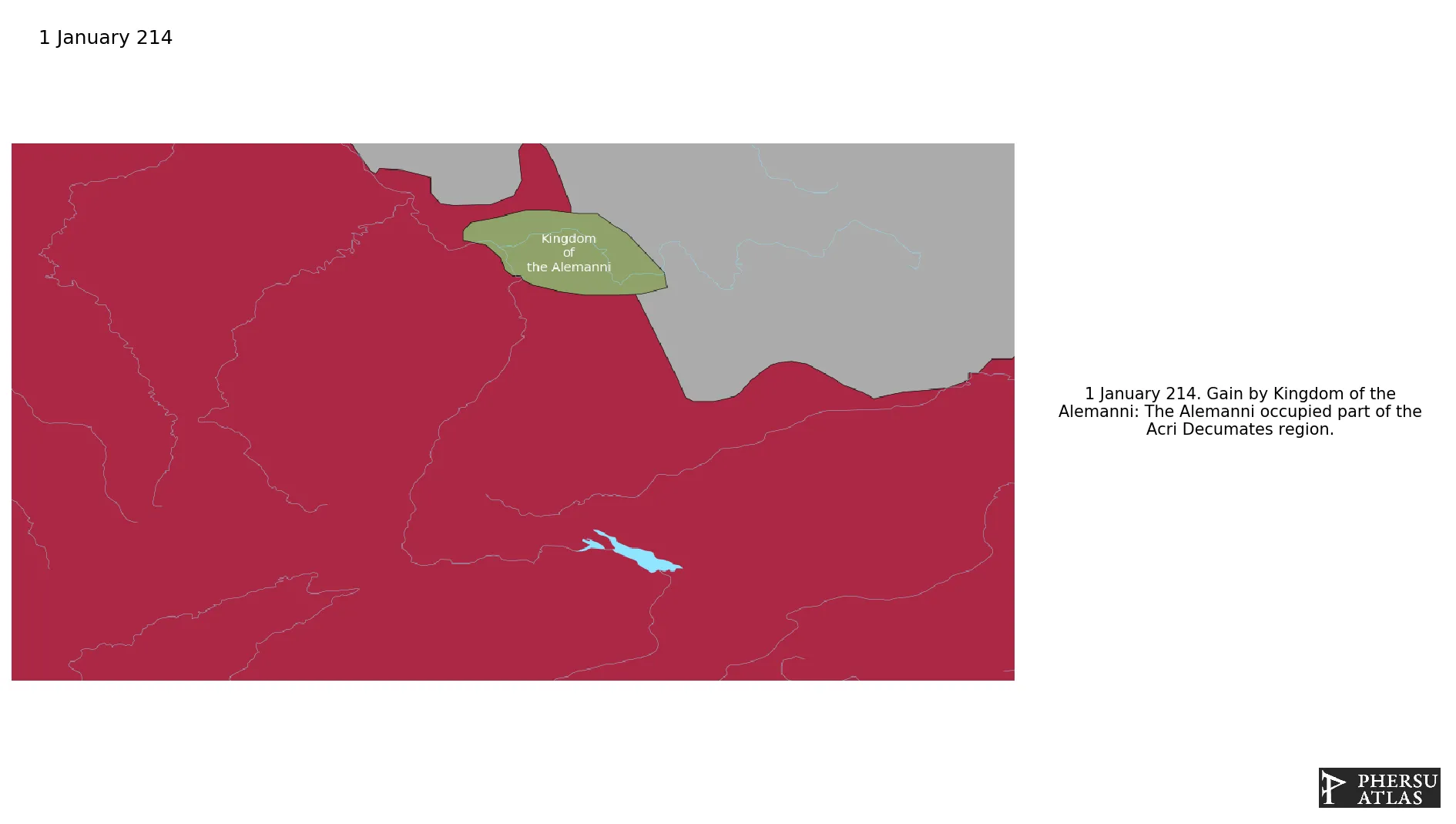
January 214: The Alemanni occupied part of the Acri Decumates region.
Chronology
Interactive Chronologies with maps are available in the section Changes Navigation
Was a period in which the Roman Empire nearly collapsed due to invasions and secessions. In particular, the period saw the creation of two secessionist states: the Gallic Empire andhe Kingdom of Palmyra.
1.1.Barbarian invasions of the Third Century
Were a series of Barbarian invasions of the Roman Empire during the Crisis of the Third Century.
1.1.1.Evacuation of the Agri Decumates
Romans controlled the Agri Decumates region until the mid-3rd century, when the emperor Gallienus (259-260) evacuated it before the invading Alemanni.
January 261: The Romans evacuated most of the Agri Decumates region before the invading Alemanni.
January 299: Alemanni expansion into the Agri Decumates, a region of the Roman Empire's provinces of Germania Superior and Raetia.
January 358: Alemanni expansion into the Agri Decumates, a region of the Roman Empire's provinces of Germania Superior and Raetia.
January 379: Alemanni expansion into the Agri Decumates, a region of the Roman Empire's provinces of Germania Superior and Raetia.
Were a series of conflicts that saw the Huns, an invading tribe probably from Central Asia, fighting against the Romans as well as the Germanic tribes of Europe.
2.1.Hunnic Invasion of Europe
The Huns invaded Europe starting with the Ukrainian Steppe.
2.1.1.Thuringia is conquered by the Huns
The Huns conquered the territories occupied by the Thuringians.
January 401: After the death of King Gunther, the Thuringians were conquered by the Huns under the leadership of Attila the Hun in 400 AD. This marked the beginning of Hunnic rule over the Thuringian territories in present-day Germany.
2.2.Hunnic Expansion
Were the expansion wars of the Huns, who established a vast, but short-lived, dominion in Europe.
January 433: The king of the Huns Rugila greatly expanded the Hunnic Empore. The Huns achieved supremacy over their rivals, many of them highly civilized, thanks to their military prowess, mobility and weapons such as the Hunnic bow.
2.3.Hunnic Invasion of Gallia
Invasion of Gaul by the Huns under king Attila.
January 452: Honoria, the sister of Roman Emperor Valentinian III, sent a plea for help to Attila, King of the Huns, along with her ring. Attila interpreted this as an offer of marriage, and he claimed half of the Western Roman Empire as her dowry. Subsequently, the Huns invaded northern Gaul, where they occupied several major European cities, including Reims, Strasbourg, Trier, and Cologne.
February 452: Attila was defeated by Roman General Flavius Aetius in the Battle of the Catalaunian Plains. The Huns left the Roman territories they had occupied in Gaul and central Europe.
2.4.Germanic-Hunnic Wars
Was the conflict between the Germanic Tribes of central and eastern Europe against the Huns.
2.4.1.Battle of Nedao
The Battle of Nedao was a battle fought in Pannonia in 454 CE between the Huns and their former Germanic vassals. It was decisive Germanic victory.
January 455: The Battle of Nedao was a battle fought in Pannonia in 454 between Huns and their former vassals. Nedao is believed to be a tributary of Sava river. Hunnic dominance in Central and Eastern Europe was broken as a result of the battle.
At the end of 406 AD a large group of Alans, Suebi and Vandals invaded the Roman Empire.
January 408: A barbarian horde of extraordinary proportions, made up of Vandals, Alans and Suebi, driven westward by the Huns, crossed the frozen Rhine and penetrated into Gaul.
The Roman province of Gallia Belgica was occupied by Germanic tribes.
January 421: The Franks, together with the Burgundians and the Alemanni, settled in the area around the Rhine.
In 453, the Rugii successfully rebelled against the Huns along with other Germanic tribes at the Battle of Nedao, after which they settled in a region presently part of Lower Austria (ancient Noricum), north of the Danube.
January 455: In 453, the Rugii successfully rebelled against the Huns along with other Germanic tribes at the Battle of Nedao, after which they settled in a region presently part of Lower Austria (ancient Noricum), north of the Danube.
Western Roman Emoperor Majorian was assassinated and overthrown by Ricimer.
September 461: When Western Roman emperor Majorian was killed on the orders of Ricimer in 461, general Aegidius maintained his own rule in the remnants of Roman Gaul that came to be known as the Domain or Kingdom of Soissons.
The Franks invaded the Domain of Soissons.
January 477: After Gaul had increasingly slipped away from Western Roman control since the death of the power-conscious general Aëtius in 454, the Franks used the collapse of the Western Roman Empire, which had been shattered by civil wars (around 476), to fill the power vacuum that had arisen and take over their territory on their own enlarge, similar to the Visigoths in the south.
Was a war between the Frankish Kingdom and the Kingdom of the Alemanni, both kingdoms created on Roman territory by Germanic peoples during the migration period.
January 497: In 496 Frankish kinf Clovis attacked the Alemanni and subdued them.
During the Gothic War against the Byzantine Empire, the Ostrogoths ceded Provence to the Frankish Kingdom.
January 538: In 537, a conflict broke out between the Eastern Roman Empire and the Ostrogothic kingdom. To ensure Frankish neutrality in the conflict, King Vitiges offered Provence, which the Frankish Kings shared between them, along with the northern Alps with sovereignty over the Alemanni, by grabbing the upper Rhine valley, Main, and high Danube. When the Ostrogoths ceded Provence to the Franks, he (Chlothar) received the cities of Orange, Carpentras, and Gap.
Were a series of conflicts between the Roman Empire and the Goths.
10.1.Gothic War (535-554)
Was a war between the Eastern Roman Empire and the Ostrogothic Kingdom of Italy. The war had its roots in the ambition of the Eastern Roman Emperor Justinian I to recover the provinces of the former Western Roman Empire, which the Romans had lost to invading barbarian tribes.
10.1.1.First Intervention (Gothic War)
Was the first Eastern Roman campaign in Italy under General Belisarius during the Gothic War (535-554).
September 539: Frankish raid in Liguria.
October 539: After their raid, the Franks left Liguria.
The Frankish Kingdom was partitioned and reuinited several times as the Frankish rulers used to divide their territories equally among their heirs. This lead also to a number of wars and revolts.
11.1.War between Theudebert and Theuderic
Was a war between two Teilreiche (polities emerging from the hereditary divisions of the Frankish Kingdom that repeatedly divided and reunited) of the Frankish Kingdom.
January 611: In 610, Theudebert II, the King of Metz, took control of the Duchy of Alsace from Theuderic II, the King of Burgundy. This event was part of the power struggles between the Merovingian kings in the region during that time.
Was a council meeting at Cannstatt, now a part of Stuttgart, in 746 that took place as a result of an invitation by the Mayor of the Palace of Austrasia, Carloman, the eldest son of Charles Martel, of all nobles of the Alemanni. Carloman arrested several thousand noblemen who attended accusing them of taking part in the uprising of Theudebald, Duke of Alamannia and Odilo, Duke of Bavaria, and summarily executed them all for high treason.
January 747: According to the annals of Metz, the annales Petaviani and an account by Childebrand, Carloman arrested several thousand noblemen who attended accusing them of taking part in the uprising of Theudebald, Duke of Alamannia and Odilo, Duke of Bavaria, and summarily executed them all for high treason. The number of deaths is a matter of debate. The action eliminated virtually the entire tribal leadership of the Alemanni and ended the independence of the duchy of Alamannia, after which it was ruled by Frankish dukes.
January 552: In surviving records, the Bavarian name was first mentioned historically by the Franks in a list of peoples, prepared in c. 520 AD. The first document that also describes their location (east of the Swabians) is the History of the Goths by the historian Jordanes dating from 551 AD. Probably the Bavarians invaded Austria and southeastern Germany at the time of the Gothic-Byzantine wars.
Disestablishment
January 747: According to the annals of Metz, the annales Petaviani and an account by Childebrand, Carloman arrested several thousand noblemen who attended accusing them of taking part in the uprising of Theudebald, Duke of Alamannia and Odilo, Duke of Bavaria, and summarily executed them all for high treason. The number of deaths is a matter of debate. The action eliminated virtually the entire tribal leadership of the Alemanni and ended the independence of the duchy of Alamannia, after which it was ruled by Frankish dukes.

 kingdom of the alemanni


